Executive Summary
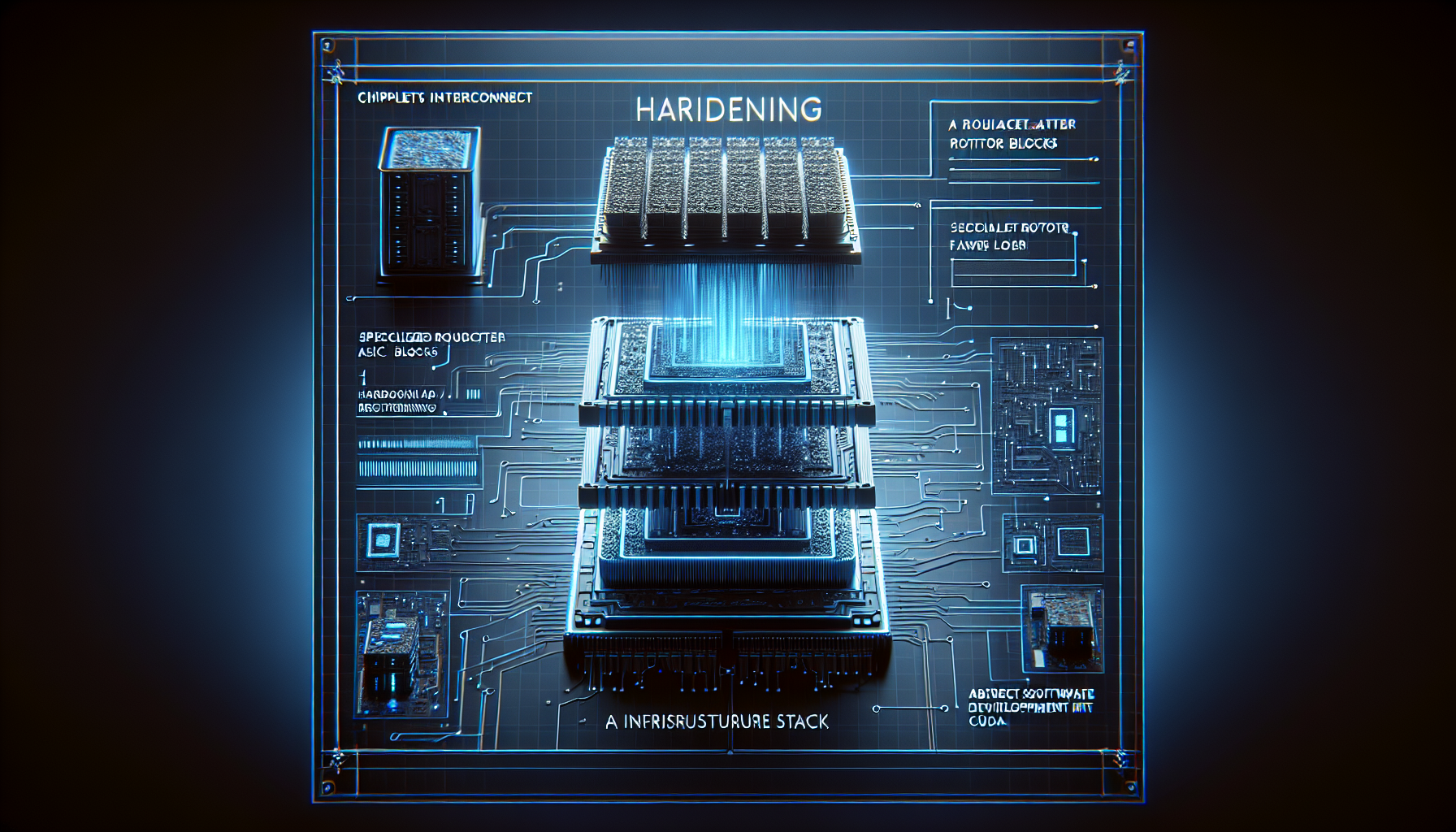
Performance leadership will hinge on end-to-end bandwidth orchestration—within packages and across racks—rather than peak FLOPs. The hardened stack works by turning die boundaries into low-latency fabric, treating routers as in-network memory arbiters, and exposing communication as a first-class API so kernels can saturate links deterministically. Practically, chiplet complexes can scale HBM-proximate compute without proprietary glue; deep-buffered, high-radix fabrics collapse tiers and absorb collective bursts; and runtimes reduce CPU orchestration while mapping collectives onto these topologies. The strategic shift is vertical co-design: package topology, fabric radix, buffer policies, and collective algorithms must be jointly planned, with telemetry and queue controls wired into schedulers. Procurement follows suit—buy components that expose knobs and counters—and operations prioritize latency determinism, real-time observability, and power-thermal co-management.
The Vector Analysis
Chiplets Grow Up: UCIe 3.0 turns package boundaries into highways
At the foundation of a hardened AI infrastructure stack is die-to-die bandwidth and coherency. UCIe (Universal Chiplet Interconnect Express) exists to make chiplets from different sources talk over a common, multi-layered protocol—comprising a physical (PHY) layer, a Die-to-Die Adapter layer, and a protocol layer on top—so designers can split large monolithic dies across multiple chiplets without sacrificing performance. The newly released UCIe 3.0 specification focuses on exactly the pressure points that AI accelerators expose: link speed, efficiency at very short reaches, and systemization of how streaming and transaction traffic share the fabric. According to an overview of the spec update, UCIe 3.0 delivers a “big speed up” and feature expansion over prior versions, targeting higher per-lane data rates and better utilization in advanced packaging environments like 2.5D interposers and organic substrates alike (ServeTheHome).
How it works in practice: AI accelerators are increasingly multi-chip modules constrained by reticle limits and yield economics. Die-to-die links must behave more like on-die networks—low latency, high bandwidth, predictable quality of service—while remaining vendor-neutral. Faster UCIe lanes and refined protocol semantics mean:
– Wider HBM-attached compute complexes assembled from multiple core chiplets become practical.
– Memory-side chiplets (e.g., SRAM/HBM cache slices, media controllers) can be composed with compute tiles without proprietary glue.
– Co-packaged I/O (CPO) paths can be rationalized around fewer, faster chiplet link groups, simplifying the reticle-to-reticle floorplan.
The net effect is a key step from general-purpose packaging to a purpose-built AI stack, where the “bus” inside the package becomes as critical to model throughput as the external network.
The Fabric Becomes a Co-Processor: Jericho4’s 51.2 Tbps and 3.2 Tbps HyperPorts
Scaling AI clusters is increasingly a networking problem: collective operations, congestion management, and hot-spot mitigation dominate time-to-train beyond a few thousand GPUs. Broadcom’s Jericho line is designed as deep-buffered routing silicon for large-scale fabrics. The latest generation, Jericho4, is now shipping at 51.2 Tbps total switching capacity—enough to present, for example, 64x800G or 128x400G ports—and introduces 3.2 Tbps “HyperPorts” for ultra-high-capacity links used to collapse tiers or stitch modular systems with fewer bottlenecks (ServeTheHome).
How it works for AI workloads:
– Deep buffers soak incast bursts common in all-reduce and parameter-server patterns, preventing PFC storms and tail latency explosions.
– High-radix configurations with 3.2 Tbps HyperPorts reduce hop count in spine/leaf designs, enabling flatter fabrics and better bisection bandwidth.
– Deterministic QoS and load-balancing primitives allow in-network optimization of collective traffic, making the “AI router chip” effectively part of the accelerator’s extended memory hierarchy.
Jericho4’s specialization signals the market’s shift from generic datacenter Ethernet to an AI-optimized interconnect layer, where the route engine and buffer architecture are tuned for the quirks of tensor-parallel and pipeline-parallel training.
CUDA 13.0 as the Contract Surface: Toolchains that expose hardware, not hide it
At the software layer, the CUDA toolkit is the de facto API for accelerated compute. CUDA 13.0’s release continues the cadence of aligning compilers, runtime, and libraries with the latest GPU capabilities and OS/driver stacks, providing the hooks needed for developers to target multi-GPU, multi-node systems more deterministically (ServeTheHome). While individual features evolve each release—compiler and PTX updates, graph execution improvements, library updates (NCCL, cuBLAS, cuDNN), and broadened platform support—the strategic throughline is consistent: reduce host overhead, maximize kernel concurrency, and expose communication as a first-class operation.
How it works in the hardened AI stack:
– CUDA Graphs and stream-ordered memory operations shrink CPU orchestration costs, which matter disproportionately at cluster scale.
– Library-level collectives (NCCL) map more efficiently onto specialized fabrics and high-radix topologies, taking advantage of router capabilities such as Jericho4’s buffering and link speeds.
– Toolchain parity with new GPU generations ensures that when chiplets and interconnects unlock more on-package bandwidth, kernels and runtime can actually consume it without re-architecting applications.
Together, UCIe 3.0, Jericho4, and CUDA 13.0 form a coherent evolution: silicon packaging creates bigger local “islands of bandwidth,” networking stitches those islands at cluster scale, and software normalizes the complexity so applications can ride the curve.
Strategic Implications & What’s Next
Bottlenecks Migrate: From FLOPs to feed-and-bleed
As the AI infrastructure stack hardens, the constraint shifts from peak compute to sustained data movement. Expect the next two to three years to prioritize:
– Package-local bandwidth orchestration: UCIe 3.0-class links elevating die-to-die routing, flow control, and memory-side caching policies to near on-die expectations (UCIe 3.0).
– Fabric-aware software paths: CUDA 13.0-era runtimes leaning harder on graphs and asynchronous collectives to overlap compute, memory, and I/O without CPU intervention (CUDA 13.0).
– Topology as a design variable: Jericho4-scale routers with 3.2 Tbps HyperPorts enabling flatter, high-bisection networks that are explicitly targeted by distributed training planners (Jericho4).
In short, performance leadership will accrue to teams that treat bandwidth provisioning and traffic shaping as co-equal to FLOP provisioning.
The New Build vs. Buy: Chiplet marketplaces meet vertically tuned fabrics
Standardized chiplet interconnects invite a different supply-chain calculus. With UCIe 3.0, vendors can mix compute, memory, and I/O tiles from multiple sources inside a single module, compressing time-to-market and enabling SKU agility. But specialization at the network layer (Jericho4-class silicon) and in the software stack (CUDA 13.0 libraries and drivers) nudges integrators toward vertically tuned solutions where:
– The die-to-die topology (number of compute tiles, memory chiplets) is co-optimized with the external network radix and link rate.
– Router buffer policies and ECN/PFC strategies are matched to the collective algorithms chosen in NCCL and friends.
– Procurement favors components that expose low-level knobs—telemetry, queueing, lane utilization—so runtime systems can adaptively steer work.
This is the hallmark of a purpose-built AI stack: interchangeable parts, but only performant when composed with shared assumptions from package to rack.
Engineering Priorities for the 2–3 Year Horizon: Determinism, observability, and thermal budget
Hardened infrastructure raises the bar on operational detail:
– Deterministic latency across boundaries: With UCIe 3.0 pushing die-to-die speeds, designers must ensure clocking, lane training, and retry mechanisms don’t inject jitter that breaks tightly synchronized kernels (UCIe 3.0).
– Fabric observability as a product feature: Jericho4-class devices need to expose per-queue, per-flow, and per-link telemetry at training timescales so schedulers can respond to emerging congestion patterns in seconds, not minutes (Jericho4).
– Thermal and power co-design: Higher-density chiplets can create local hot spots, and 51.2 Tbps-class routers like Jericho4 are engineered for high throughput with improved efficiency per bit but still impose substantial power and cooling requirements. Packaging, board design, and rack-level cooling must be planned around worst-case collective bursts and sustained memory bandwidth, with software (CUDA 13.0 runtime and libraries) participating via power-aware scheduling (Jericho4; CUDA 13.0).
The throughline is clear: the hardening of the AI infrastructure stack is less about any single breakthrough and more about tight coupling across chiplet interconnects, AI-optimized routing silicon, and toolchains that can measure, schedule, and saturate the entire system end to end.
About the Analyst
Leo Corelli | Semiconductor & Hardware Vector Analysis
Leo Corelli models the future of silicon. By analyzing supply chain data, patent filings, and performance benchmarks, he identifies and maps the vectors of hardware innovation. His work provides a rigorous, data-driven forecast of where the industry is heading.