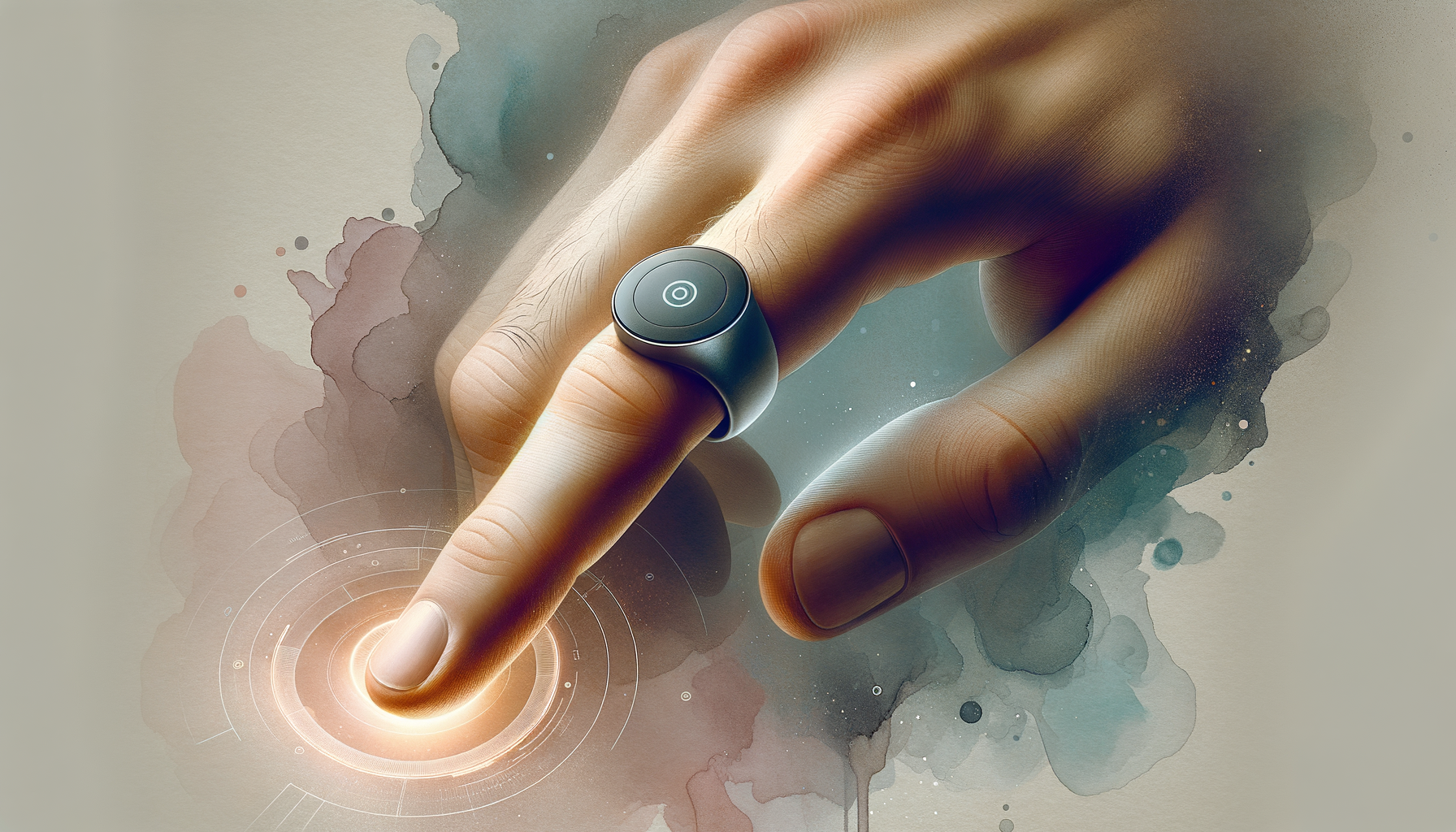
You are washing dishes when a work problem resolves itself in your head. Normally, the idea would hover just long enough for you to rinse a plate, dry your hands, unlock your phone, find the right app—and lose the thread. The Pebble Index 01 smart ring is designed to make that moment feel different: press your ring, speak, and get back to the sink while your devices remember it for you.
The Pebble Index 01 smart ring, a new “external memory” device from the resurrected Pebble crew, is built around that kind of fleeting thought rather than your resting heart rate. In a market obsessed with sleep scores and readiness metrics, it is almost defiantly simple: a button, a microphone, local storage, and no health tracking at all, according to early coverage and hands-on previews from outlets like Ars Technica and Wired. It is a wager that the next useful thing on your body may not be a sensor-laden monitor, but a quiet input device for AI and productivity tools.
Why the Pebble Index 01 Smart Ring Matters Now
Over the last decade, wristbands and rings have framed their value around quantifying the body—heart rate variability, sleep staging, recovery trends—backed by increasingly dense dashboards and, often, recurring subscription fees. The baseline expectation for a “smart” wearable is now that it will watch you, score you, and nudge you toward better habits, as evidenced by marketing from health-focused rings like Oura and Ultrahuman.
At the same time, a visible countercurrent has emerged. Surveys and anecdotal reports show users abandoning health wearables after an initial novelty phase, either because the numbers become repetitive or because another daily score adds to, rather than relieves, stress. Research on fitness trackers from institutions such as the University of Chicago and reporting in mainstream outlets have documented this pattern of “tracker fatigue,” where step counts and sleep graphs lose their pull once the novelty fades.
The Pebble Index 01 smart ring arrives exactly at that moment—and just as AI assistants, from ChatGPT to smartphone-native copilots, are shifting from novelty to everyday tool. It takes the bet that people increasingly want wearables that help them capture and control, not only quantify. For users already experimenting with AI note-takers and copilots, the ring tries to compress the whole capture flow into a single press: record, sync, transcribe, and route into an existing productivity stack.
The shifting wearable baseline for smart rings in 2025
In this landscape, the Pebble Index 01 smart ring is deliberately out of step. Priced at an early preorder level around $75, rising to a planned $99, it promises multi‑year battery life with no charger and no subscription upsell, according to hands-on write‑ups from sites like Ars Technica and Wired.[^1] Instead of an optical heart-rate array, it uses sealed silver‑oxide hearing-aid cells and a single thumb‑activated button.
The contrast to Oura, Ultrahuman, and the upcoming Galaxy Ring is stark: those devices justify higher prices with dense sensor stacks and software layers that promise to interpret your physiology. The Index 01 implicitly asks a different question: what if the main job of a ring is not to know you better, but to help you act on what you already know?
What the Pebble Index 01 Smart Ring Actually Is
Hardware: how the Index 01 smart ring’s button-first design works
Up close, the Pebble Index 01 smart ring resembles a slightly chunky signet rather than a delicate band. The stainless steel shell comes in black or polished metallic finishes and spans common ring sizes; inside, hearing‑aid‑style batteries are sealed for roughly two years of use, at which point Pebble recommends recycling the ring and buying a replacement.[^1] It is water‑resistant enough for showers or rain, though not designed for deep swims.
On the outer surface sits the defining feature: a physical button that doubles as a subtle ridge. Nestled alongside is a microphone tuned for clear speech capture at typical hand‑to‑mouth distances, even in noisy environments. There is no display, no heart‑rate sensor, no haptics or vibration motor advertising incoming alerts.[^1]
In daily use, the Index 01 smart ring is closer to a compact signet ring than a chunky gadget. The stainless steel chassis resists everyday scratches, and the sealed battery design means no charging ports to fail over time—at the cost of treating the ring as a long-lived consumable rather than a permanent object.
Core functions: using the Index 01 smart ring to capture moments and trigger actions
Functionally, the Pebble Index 01 smart ring does three things:
- Press‑and‑hold to record short audio clips—up to a few minutes—stored locally and synced to a phone for playback and transcription.
- Single or double presses as programmable input gestures, mapped to tasks like media control, camera shutter, or messaging shortcuts.
- Acting as a discreet, always‑on‑your‑hand trigger for AI workflows that live on your phone or in the cloud.
The companion app, expected for iOS and Android at launch, will handle Bluetooth pairing, encryption, and optional transcription, using phone and cloud resources rather than trying to run models on the ring itself.[^1] Pebble’s team emphasizes that recordings stay on the phone by default; cloud services are opt‑in and, in some cases, intended to be open‑source or user‑selectable so that power users can plug in their own tools.[^1]
Those clips can then feed straight into AI tools for summarizing meetings, drafting follow‑up emails, or creating tasks, turning the Pebble Index 01 smart ring into a physical “record and route” button for your digital brain.
A deliberate rejection of health-tracking smart rings
No sensors, no scores, no subscriptions on the Index 01 smart ring
The absence of biometric sensors is not a cost‑cutting accident; it is a design stance. Where Oura’s marketing centers sleep staging and readiness scores and other competitors emphasize metabolic health or stress, the Pebble Index 01 smart ring ships with zero physiological insight.[^1] There are no nightly ratings, no step counts, and crucially no paid tier to unlock deeper analysis.
In an era when many wearables push their most useful insights behind subscriptions, turning hardware into a gateway for ongoing revenue, the Index 01’s flat pricing is almost retro. Pebble is positioning this as ethical as much as practical: you buy a tool, it does its job, and the company has fewer incentives to nudge you into more engagement than you really want.
If you want detailed sleep staging or recovery scores, an Oura, Ultrahuman, or Galaxy Ring will still be a better fit. The Pebble Index 01 smart ring is for people who already track health elsewhere—or have decided not to—and care more about frictionless idea capture.
How Index 01 responds to fitness-tracker fatigue and data skepticism
This anti‑tracker posture speaks to a growing ambivalence about lifelogging. Long‑term studies have found that while activity trackers can improve short‑term motivation, their effects often wane without strong personal meaning or clinical support. Informally, many users describe feeling judged by their own devices—or guilty for ignoring them once the data stops feeling actionable.
By refusing to measure your body at all, the Pebble Index 01 smart ring offers a different contract: it will not tell you how you slept, but it will be ready the instant you have an idea about what to do with your day. That trade can feel oddly liberating. Instead of another channel of self‑surveillance, the ring aspires to be more like a mechanical pencil—an everyday object that extends your mind rather than scans your body.
From health tracker to controller: a new role for smart rings
The Index 01 smart ring as input device, not notification mirror
Pebble’s original smartwatch became beloved not because it was the most advanced screen on the wrist, but because its buttons and glanceable faces fit neatly into daily rituals. The Pebble Index 01 smart ring tries to bring that ethos to the finger. Its primary role is neither to buzz with notifications nor to light up with information; it is to give you a tiny, reliable “do something” surface that is closer at hand than your phone.
Practically, that means fewer interruptions and more intentional actions. The ring stays silent until you press it. A long‑press captures that half‑formed thought while you are driving or walking the dog. A quick press might log the moment to your journal or trigger a smart‑home scene. Over time, that rhythm could invert the usual relationship with wearables: instead of your devices constantly reaching for your attention, you reach out to them when you choose.
How the Index 01 smart ring fits AI-native workflows
Because the Pebble Index 01 smart ring mostly emits audio files and button events, it slots naturally into the growing ecosystem of AI tools that can transcribe, summarize, and act on spoken language. Pebble has signaled an intent to support open standards for connecting the ring to third‑party agents and note‑taking tools, so that developers can wire it into their own systems rather than treating it as a closed accessory.[^1]
This is where the device’s simplicity becomes an affordance. A ring that tries to be a little smartwatch on your finger has to pick sides: which assistant, which ecosystem, which UI? An input‑only ring can remain ecumenical. It is an endpoint that simply says, “the wearer is speaking now,” and lets the user decide whether that speech feeds into a corporate CRM, a personal knowledge base, an accessibility tool, or a private journal.
Productivity niche vs mass-market health-tracking rings
What the Index 01 smart ring offers that Oura-style health rings don’t
Against a backdrop of glossy health rings, the Pebble Index 01 smart ring’s strongest argument is its reliability for a small set of use cases. A physical button is hard to mis‑trigger: you feel the click, you know it is recording. That matters if you are capturing a key point in a meeting, a phone number shouted across a noisy street, or a late‑night idea you will not remember in the morning.
Health‑centric rings do offer some input functions—touch‑based playback controls, gesture recognition—but they are secondary to sensing and typically buried in multi‑function surfaces. For a subset of knowledge workers, parents, and creatives, the clarity of “this ring is my capture button” could be more valuable than one more stream of sleep statistics.
Within that group, success looks like deep, habitual use rather than a huge installed base. The key metric will not be how many units ship on launch day, but how many owners are still pressing the button many times a day once the novelty wears off.
Trade-offs of an input-first smart ring: narrower use case, smaller audience
The risk is that this clarity also narrows the audience. For many buyers, the appeal of a ring or watch is precisely that it promises to condense multiple functions—fitness tracker, notification mirror, contactless payment—into a single object. By ignoring wellness entirely and sidestepping payments, the Pebble Index 01 smart ring is effectively betting on a user who either gets health data elsewhere or has decided they do not care.
Pebble’s own messaging, as reported in early coverage, seems to accept that it may be building for a niche: people who already carry notebooks, dictate to their phones, or maintain systems like Obsidian or Notion to offload memory.[^1] For them, the ring is less a lifestyle accessory and more a new kind of input terminal.
Privacy, listening, and the ethics of an audio-recording smart ring
Opt-in, button-press recording as a core Index 01 design choice
Any device that can record audio on the body raises familiar anxieties about surveillance. Pebble tries to disarm some of those fears through basic architecture choices: there is no always‑listening wake word, no passive logging, and no forced cloud account to make the ring function.[^1] Recording requires an explicit press, with cues on the phone confirming capture.
From a trust‑signal perspective, this is crucial. People may be willing to wear microphones in public if they feel firmly in control of when those microphones are active, and if their companions can tell at a glance. Transparent indicators—subtle LEDs, audible beeps, or screen banners—turn an invisible capability into a social contract. Whether Pebble nails that signaling will shape not only regulatory perceptions but also whether colleagues and friends feel comfortable around the device.
For most users, a simple rule of thumb applies: treat the Pebble Index 01 smart ring like a voice recorder—ask before recording others, avoid sensitive spaces, and check local recording laws if you plan to use it at work.
Social friction of wearing a microphone-forward smart ring in public
Even with opt‑in capture, the Pebble Index 01 smart ring will meet resistance in certain contexts. Recording at work can trigger HR concerns; recording in public encounters a patchwork of single‑party and all‑party consent laws; and even when it is lawful, it may not feel polite.
Users will likely develop their own rituals to manage this friction: raising the ring to their mouth as a visible cue; prefacing a press with a quick “I’m just making a note”; avoiding use in sensitive meetings or private spaces. As with early experiments in camera‑equipped glasses or lapel AI pins, the cultural question is whether the object reads as experimentation, intrusion, or simply another tool. Pebble’s design restraint—the lack of cameras, the requirement of a press—tilts the balance toward “tool,” but norms will take time to settle.
For a broader look at how microphone-forward wearables are colliding with norms around public recording and identity, see this site’s analysis of device-level age verification and OS-level identity checks, which traces similar battles over who controls sensors and signals on personal hardware.
Design, comfort, and the Pebble smart ring legacy
Lessons the Index 01 smart ring borrows from Pebble’s original smartwatch
Pebble’s history matters here because it shapes expectations. The company’s first watch was beloved for battery life, physical buttons, and an open developer community that explored oddball use cases far beyond the original pitch. Early coverage of the Pebble Index 01 smart ring notes the same instincts: durability over fashion, hackability over sealed ecosystems, simple interactions over glossy screens.[^1]
The reliance on a sealed, non‑rechargeable battery underscores this philosophy. Pebble argues that hearing‑aid‑style batteries are more reliable, less finicky, and free owners from daily charging rituals that often kill wearable habits. Critics, however, see e‑waste and planned obsolescence in a product that must be replaced outright when the cells deplete.[^1]
Form factor realities of an input-first smart ring
Comfort will be another adoption hinge. For a device you might press a dozen times a day, a slightly larger, easier‑to‑find button ridge can be an asset. But jewelry norms vary widely, and some potential users—especially those used to thin bands or no rings at all—may find the Pebble Index 01 smart ring conspicuous.
That visibility cuts both ways. For early adopters, a recognizable “tech ring” can function as a conversation starter and a subtle status symbol, much like noise‑canceling headphones or mechanical keyboards do today. For others, conspicuousness might be exactly what keeps the ring in the box after the first week. Pebble will have to learn, probably over a couple of hardware revisions, how far it can push utility without losing the comfort and aesthetics that make constant wear possible.
Platform, integrations, and developer potential of Index 01
How the Index 01 smart ring plugs into existing AI and app ecosystems
On paper, the technical story is straightforward: the ring pairs to a phone via Bluetooth, the app syncs encrypted clips in the background, and users route those clips into preferred services. In practice, small frictions—lag on button press, unreliable pairing, awkward permissions dialogs—can make or break the illusion that the ring is just “there” when you need it.
Pebble has talked about integrations with its own legacy watches, using them as playback or control surfaces, and about supporting mainstream note apps and cloud drives so that ring captures can land where people already store their work.[^1] In practice, that might mean sending clips to Notion, Obsidian, or a dedicated AI notebook, or wiring the Pebble Index 01 smart ring into automation platforms so a long‑press automatically creates a dated note or task.
That ecosystem story echoes broader shifts in how operating systems are becoming “live model surfaces” for AI rather than static plumbing. Android’s recent pivot toward AI‑mediated notifications, for example, shows how quickly platforms are turning raw inputs like text and voice into summarized context; the Index 01 is a hardware on‑ramp into that same pattern.[^2]
Opening the Index 01 platform to power users and builders
If Pebble leans into its historic developer friendliness, the Pebble Index 01 smart ring could become an appealing canvas for tinkerers. Potential experiments include:
- Custom multi‑press patterns that kick off different automations on desktop or mobile.
- Team tools that let meeting participants tag moments, then share time‑stamped summaries afterward.
- Accessibility workflows where speech‑to‑text and text‑to‑speech loops help users with motor or cognitive impairments capture and retrieve information.
None of these are guaranteed; they depend on clear APIs, documentation, and the patience of a community. But history suggests that even a small base of enthusiasts can extend a simple hardware product into a surprisingly rich ecosystem.
Competitive landscape: other input-first wearables and smart rings
Rings, pins, and clips chasing the AI remote-control vision
The Pebble Index 01 smart ring does not emerge in a vacuum. Over the last few product cycles, companies have launched AI pins, pendant recorders, and microphone‑forward earbuds that promise to offload not just thoughts but full‑blown life logs to large language models. Some of these devices struggle with unclear routines: when, exactly, are you supposed to use them instead of your phone, and what do you gain beyond a slightly different form factor?
The ring format dodges some of those questions by being inherently on‑you and hand‑adjacent. Unlike a lapel pin, it is less likely to be left on a jacket. Unlike glasses, it does not depend on your vision habits or fashion sense. Yet it shares the same underlying challenge: proving that its signature action—press, speak, release—threads into enough daily situations to justify its existence.
How Index 01 differentiates on constraint, not raw capability
What distinguishes the Pebble Index 01 smart ring in this field is its embrace of constraint. Where an AI pin might tout onboard neural processors and full‑time connectivity, the ring focuses on being dependable for a small set of tasks. It sidesteps a spec arms race in favor of a story about rituals: the dozens of tiny moments when you wish you had a third hand for your thoughts.
For buyers, that narrative is harder to communicate than a heart‑rate metric or an AI buzzword. It requires them to imagine future routines—how they might feel when dictating during a commute or while wrangling toddlers—rather than comparing features on a table. Pebble’s marketing and early user testimonials will therefore carry unusual weight in shaping perceptions.
What success for the Index 01 smart ring would look like
Adoption signals to watch for Index 01 in the mid term
Looking ahead through the next couple of hardware cycles, the most telling metrics for the Pebble Index 01 smart ring will be depth rather than breadth. If, after the initial novelty window, a meaningful share of owners are still capturing multiple clips a day and routing them into workflows they actually use, Pebble will have evidence that an input‑only ring has legs.
In the near future, expect early adoption primarily among:
- AI‑native knowledge workers who already live in tools like Notion, Obsidian, or Roam and feel the pain of fleeting, uncaptured ideas.
- Creatives and field workers—journalists, designers, researchers—whose work generates constant fragments worth saving.
As those users share workflows, tutorials, and integrations, a kind of “capture culture” could solidify around the device. If that happens, mainstream awareness may not come from Pebble’s own campaigns so much as from second‑order effects: podcast hosts mentioning the ring offhand, productivity YouTubers folding it into their setups, colleagues noticing a small but persistent ritual at the office whiteboard.
For readers interested in how similar “live surface” shifts are unfolding at the software layer, see this analysis of Android 16’s AI-first cadence, where notification summaries and system‑level models are quietly changing how mobile OSes mediate attention.
A grounded forecast for input-first smart rings and wearables
Over the mid‑term, input‑oriented wearables like the Pebble Index 01 smart ring are unlikely to displace health‑centric rings in raw numbers. Wellness remains a broad, easily communicated value proposition, and the big platforms—Apple, Samsung, Google—are deeply invested in that story.
What is more plausible is a layered ecosystem. Health rings and watches will retain their place as general‑purpose companions, while more focused tools like the Pebble Index 01 smart ring carve out roles in specific professional and enthusiast niches. Success for Pebble would look less like mass‑market dominance and more like becoming the de facto standard for “people who really care about externalizing their thoughts on the go.”
If the company can demonstrate strong retention among that group, keep the hardware dependable, and nurture a modest but vibrant developer scene, the Pebble Index 01 smart ring could quietly define a new category: an input‑first smart ring that acts as external memory for people who think with AI tools as much as with notebooks.
[^1]: Summarizing details reported in early product coverage from Ars Technica and Wired on the Pebble Index 01 smart ring.
[^2]: Discussed in this site’s coverage of Android 16’s AI-first update cadence and its shift toward notification summaries and model‑mediated UX.