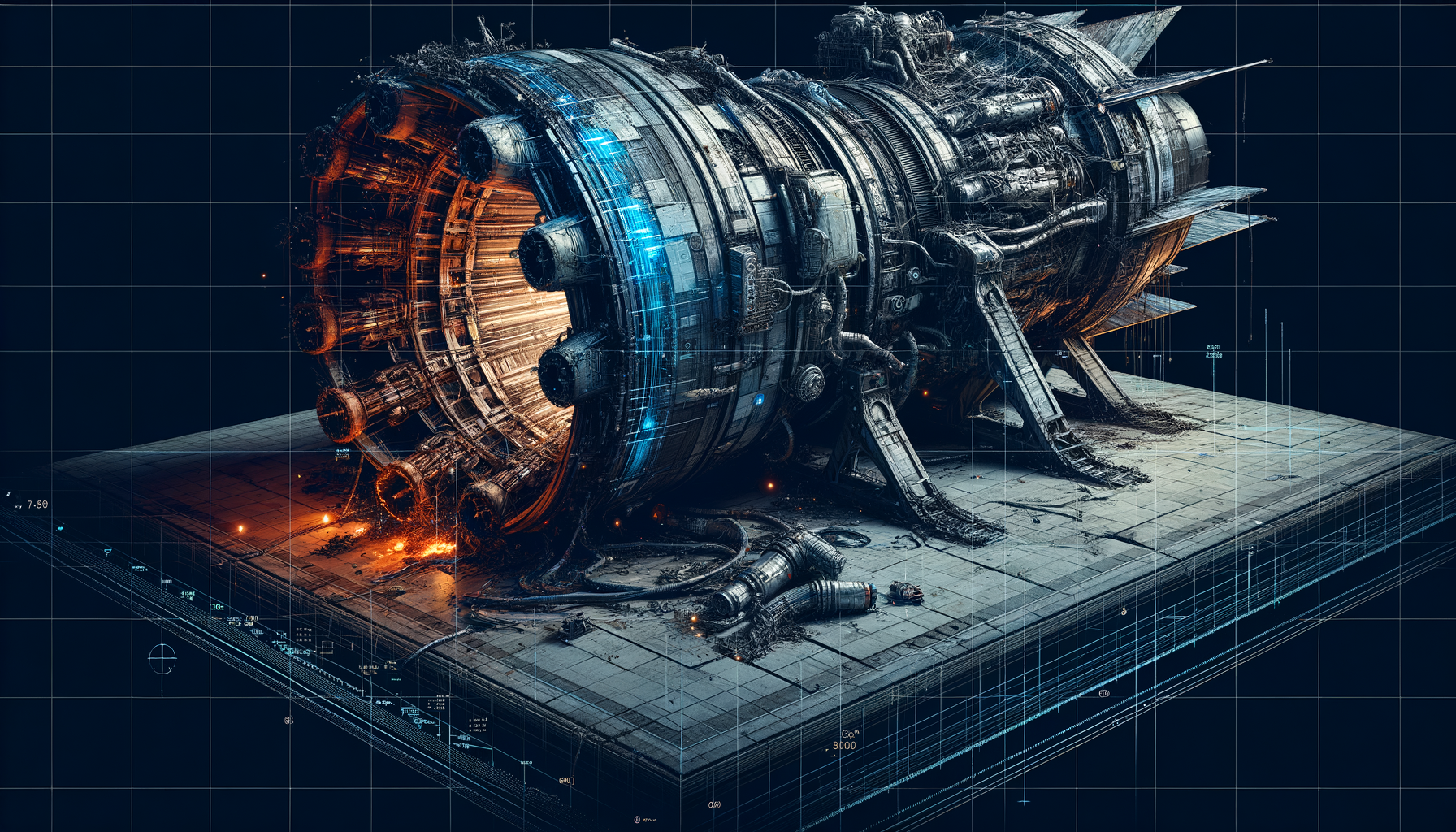
SpaceX just lost an upgraded Starship ship in an explosion and heavily damaged its newest Super Heavy booster in separate tests at Starbase. These latest Starship test failures come at a moment when the vehicle is no longer a side bet: it sits at the center of NASA’s Artemis plans, future mega-constellations, and long-horizon commercial station concepts.
The program has crossed an invisible line from experimental vehicle to de facto infrastructure. That shift makes each high‑energy failure not just an engineering data point, but a schedule and risk event for governments and companies that have already penciled Starship capacity into their roadmaps.
Why Starship’s Latest Test Failures Matter for Space Infrastructure
Two incidents in late November at SpaceX’s Starbase site in Texas reshaped the near-term outlook for the Starship program. An upgraded Starship upper stage exploded during ground testing, while the first V3‑generation Super Heavy booster, known as Booster 18, suffered major structural damage during a separate cryogenic test (TechCrunch). Neither vehicle carried payload, and no injuries were reported.
Both events removed critical hardware from the queue just as NASA, commercial constellation operators, and emerging station ventures are treating Starship availability as an input to their launch infrastructure planning. In practice, that means these November Starship test failures ripple into Artemis schedule risk, mega-constellation timelines, and the pacing of commercial station build-outs.
From Ambitious Roadmap to Systemic Dependency Risk
Starship began as a “bet the company” vision aimed at fully reusable, Mars‑capable transport. For much of its early life, it was decoupled from external commitments; failures were expected and largely internalized. That changed when NASA selected a modified Starship as the Human Landing System (HLS) for Artemis lunar missions, with a requirement for on‑orbit refueling and multiple Starship launches to support each crewed landing (NASA).
In parallel, SpaceX’s own Starlink expansion plans assumed Starship‑class lift to accelerate deployment of next‑generation satellites, while commercial station concepts and in‑space manufacturing startups began marketing business models that depend on ultra‑low cost per kilogram to orbit. National security planners, too, now treat Starship as a future heavy‑lift option even as they continue to manifest payloads on Falcon 9, Falcon Heavy, and competitors.
The result is a subtle but important dependency inversion. Instead of customers flexing to fit around a high‑risk R&D program, the maturing ecosystem increasingly assumes that Starship will reach a certain reliability and cadence on a specific timeframe. The latest failures underscore how fragile those assumptions remain.
Why Iterative Failure Changes Once Timelines Are Locked In
SpaceX’s development culture is built around “test to failure, then redesign,” an approach that deeply shaped Falcon 9’s evolution. Dramatic early mishaps were accepted as the price for rapid learning, and because few external milestones rested on unproven hardware, schedule slips were largely SpaceX’s problem.
Starship operates in a different regime. Artemis dates are now written into legislation and appropriations language. Commercial contracts specify delivery windows, and competing launch providers are adjusting capacity plans based on when Starship is expected to divert demand away from legacy rockets. That creates much tighter schedule margins around each anomaly.
Technically, the November events are consistent with SpaceX’s long‑standing philosophy: push new hardware hard, uncover weak points, and iterate. Strategically, they land in a phase when the same high‑risk behavior must coexist with infrastructure‑grade expectations from regulators and customers.
What Went Wrong in the Latest Starship and Super Heavy Test Failures
Both recent Starship test failures occurred during cryogenic loading of upgraded hardware, turning what should have been routine qualification runs into infrastructure-level setbacks.
The Upgraded Starship Explosion During Ground Testing
An upgraded Starship upper stage undergoing ground testing at Starbase experienced a major explosion during a cryogenic tanking run, destroying the vehicle on the stand (TechCrunch). Imagery and live streams captured a rapid sequence: venting during propellant loading, followed by an abrupt overpressure event and fireball that engulfed the ship.
This Starship iteration incorporated structural and plumbing changes relative to earlier test articles, aimed at supporting higher propellant mass, refined mass distribution, and interfaces for future in‑space refueling. It was not configured for an imminent orbital launch; the objective was to validate the upgraded tank architecture and ground systems under cryogenic conditions.
As of the latest reporting, SpaceX has not released a formal root‑cause report. External analysts who reviewed footage point to a localized failure in the tanks or associated pressurization lines as the likely initiation point, but that remains informed speculation rather than confirmed diagnosis.
Significant Damage to the New Super Heavy Booster
The more strategically significant event involved Starship’s first V3‑class Super Heavy booster, Booster 18. During a separate early‑morning cryogenic test at the Massey test site, outside the main orbital launch pad area, the booster suffered a violent structural failure that blew out a substantial section of its lower structure while leaving the main cylinder standing (Ars Technica summary via TechCrunch).
Crucially, no Raptor engines had been installed. The test focused on tanking and pressurization systems for the new V3 design, which is larger and intended to support higher performance and more robust operations than previous boosters. Early indications from SpaceX’s brief statements and third‑party analysis suggest a gas system or pressurization anomaly in the liquid oxygen tank region, rather than a propulsion‑system defect (Engadget).
High‑resolution photos after the event show extensive tearing and deformation in the lower tank area. Multiple independent analysts judge the damage as effectively irreparable for flight use, implying that Booster 18 will be retired and replaced rather than rebuilt. Given that it was the only near‑term V3 booster in advanced test, this is a significant hit to the program’s hardware queue.
Patterns in the Starship Failures and Possible Common Modes
Both incidents occurred during cryogenic loading of upgraded hardware, before engines were involved. That alone points attention toward shared elements: revised tank geometries, new plumbing for methane and oxygen, updated pressurization systems, and potentially modified insulation or structural light‑weighting choices.
The failure signatures differ—one a full‑vehicle fireball, the other a violent but geographically constrained rupture in the lower booster. That makes it unlikely that a single specific component defect explains both. More plausibly, the common thread is that Starship is entering a new design phase, with V3‑class hardware stretching pressure margins, propellant mass, and ground‑system interactions beyond the envelope previously explored.
Historically, Starship’s development arc has featured an early cluster of tank and structural failures, followed by a period of increasing success on orbital attempts. The November setbacks look less like pure regression and more like the turbulence that comes from opening a new branch of the design tree. The risk, from a systems perspective, is that each new branch resets parts of the learning curve while customers are already planning around later, supposedly stable configurations.
The High-Stakes Promise Behind Starship’s Architecture
The reason stakeholders tolerate this level of volatility is Starship’s upside. On paper, the vehicle promises capabilities well beyond any existing launcher: fully reusable, methane‑fueled stages; very high payload mass to low Earth orbit; and aggressive reflight tempos.
Mass to Orbit, Rapid Reuse, and Cost per Kilogram
SpaceX’s public materials and independent analyses project Starship’s payload capacity to low Earth orbit on the order of 100 metric tons or more, with a pathway to significantly higher figures in expendable or partially expendable configurations (SpaceX; Wikipedia). Combined with rapid reuse—targeting turnaround timelines closer to aviation than traditional rocketry—that unlocks a cost per kilogram substantially below Falcon 9 and existing heavy‑lift competitors, at least in theory.
Those unit economics underpin a raft of business cases. Starlink’s next generation requires mass deployment of larger, more capable satellites. Concepts for fuel depots, on‑orbit assembly yards, and bulk cargo runs to the Moon or Mars all assume that lifting hundreds of tons per campaign becomes routine rather than exceptional. Without such a platform, timelines stretch and costs expand, sometimes to the point where projects no longer close financially.
Starship’s Role in NASA’s Artemis Lunar Architecture
For Artemis, Starship is not just a big rocket; it is a core architectural element. NASA’s selected HLS variant depends on a Starship lander receiving propellant in Earth orbit from a series of Starship tanker launches before it can proceed to lunar orbit and down to the surface. That implies a tightly choreographed chain: build, launch, and recover multiple Starships; demonstrate reliable on‑orbit refueling; and prove safe, repeatable lunar descent and ascent.
Any delay in Starship’s maturation reverberates through that chain. If tanker flights slip, refueling demonstrations move right. If ground‑test incidents slow hardware availability or trigger regulatory stand‑downs, the schedule slack for crewed missions erodes. NASA has already been signaling that Artemis landing dates are likely to shift, citing both Starship readiness and spacesuit development challenges (Ars Technica). The latest Starship failures reinforce that the lunar architecture is only as robust as its most immature element.
Commercial and National Security Dependence on Starship
Commercial players are hedging but not immune. Mega‑constellation operators still lean heavily on Falcon 9 today, yet many long‑term network expansion and replenishment plans assume Starship to keep launch costs and manifest complexity under control. Emerging commercial station vendors pitch resupply and module deployment concepts that hinge on Starship’s lift and fairing volume.
National security space programs, from the U.S. Space Force to allied agencies, have started to consider Starship in long‑range planning as a way to launch outsized payloads or bulk logistics hardware. While no critical defense payloads are currently dependent on Starship, expectation inertia is building: the assumption that such capability will be available changes how programs think about future architectures.
Iterative Development vs. Critical Infrastructure Expectations
A central storyline in Starship’s evolution is the collision between an agile, failure‑tolerant engineering model and the conservative norms of critical infrastructure.
SpaceX’s Philosophy: Test to Failure, Then Redesign
SpaceX has repeatedly demonstrated the upside of aggressive test‑to‑failure campaigns. Early Falcon 9 landing attempts ended in barge explosions and mangled boosters; today, booster recovery is routine, and the company has flown individual first stages dozens of times. For Starship, spectacular early failures of sub‑scale prototypes and full‑stack vehicles yielded rapid improvements in tank handling, Raptor performance, and flight software.
The advantage is straightforward: pushing hardware to its limits, and beyond, surfaces edge cases that paper analysis and limited‑scope qualification testing might miss. It also accelerates what software engineers would call the “learning rate” of the system—each destructive test can close multiple hypotheses about how the vehicle behaves in extreme regimes.
At the same time, experimental Starship test failures must now be balanced against infrastructure-grade reliability targets for missions that involve crew, national assets, and multi-billion-dollar commercial platforms.
The Constraints: Pads, Supply Chains, and Regulatory Bandwidth
As Starship’s physical scale and ecosystem entanglement grow, the brute‑force approach runs into practical constraints. Each major mishap at Boca Chica can damage scarce infrastructure: orbital pads, test stands, and propellant plumbing that take time and money to rebuild. Super Heavy V3 boosters represent a heavier investment in materials, machining, and integration time than earlier test articles; losing one is not equivalent to scrapping a small pathfinder tank.
On the regulatory side, the Federal Aviation Administration treats serious anomalies as mishaps requiring investigation, corrective action, and license review. As the incident count rises, so does scrutiny, and the time between anomaly and next flight can expand. Local environmental and community impacts—from noise to debris—add another layer of friction, as advocacy groups and residents push for tighter constraints on operations.
When Experimental Starship Hardware Becomes De Facto Infrastructure
The net effect is that Starship is slipping into the category of emergent infrastructure before it has fully exited its experimental phase. Stakeholders start to expect redundancy in pads, conservative operating envelopes, and clear separation between high‑risk experimental tests and mission‑critical hardware flows. Yet the development team is still changing tank layouts and plumbing in ways that can introduce new failure modes.
That mismatch does not make SpaceX’s approach invalid, but it does force tradeoffs. The company can lean into rapid change and accept recurring setbacks, or it can freeze a configuration earlier than ideal to give customers and regulators a more predictable platform—even if that slows ultimate performance gains.
Immediate Implications of Starship Test Failures for Launch Timelines
The central practical question is how much these November incidents actually move the needle on launch availability.
How Much Schedule Slack SpaceX Really Has on Starship
Starship’s demonstrated flight cadence so far has been modest, constrained by pad readiness, regulatory approvals, and hardware maturation. Removing an upgraded ship and the first V3 booster from the pool means that near‑term orbital tests will likely continue on earlier‑generation hardware while the V3 line regroups.
Replacing a full‑scale V3 booster is not trivial. Even at SpaceX’s high manufacturing tempo, building tanks of that scale, integrating plumbing, and qualifying the structure takes time. Losing one V3 booster likely removes at least one or two potential test windows over the next major build cycle, even before accounting for design changes that might be required.
In practical terms, the explosion and booster damage make it harder for SpaceX to substantially ramp Starship’s orbital test cadence in the near future. The company can still fly, but its margin for additional anomalies has narrowed.
Artemis Deadlines and Rising Political Pressure
For Artemis, each Starship slip amplifies existing schedule stress. NASA’s own watchdog has already warned that the initial crewed lunar landing target is unlikely under current conditions (Ars Technica). The latest failures give political actors a clearer rationale either to reset expectations formally or to demand more conservative risk postures.
NASA’s options are constrained. There is no near‑term alternative lander with comparable capability. Re‑competing the HLS award or pivoting to a different architecture would almost certainly introduce delays longer than working through Starship’s current issues. That leaves two main paths: accept a later first landing, or attempt to compress test and certification windows later in the decade—an approach that would attract scrutiny from safety advisors.
Commercial Exposure to Starship and Hedging Strategies
Commercial customers, especially constellation operators and infrastructure startups, retain more flexibility. Many already maintain backup manifests on Falcon 9, Falcon Heavy, or non‑SpaceX rockets. They can prioritize essential satellites on existing vehicles, delay discretionary capacity expansions, or adjust rollout timelines.
The problem is that alternatives cannot fully substitute for what Starship is supposed to provide. No operational rocket today combines its projected lift, volume, and low marginal cost. As a result, hedging strategies tend to buy schedule insurance in the near term while leaving the long‑range dependence on Starship intact. Repeated Starship test failures may push some customers to formalize contingency architectures rather than treating them as informal backstops.
For context on how such hedging has played out with other launch systems, see our analysis of how mega-constellations diversify launch risk and why operators still cluster around a few providers.
Regulatory and Safety Oversight After Starship’s High-Visibility Failures
Every high‑energy anomaly feeds into a feedback loop of scrutiny from regulators, local communities, and international observers.
FAA Investigations and Starship Launch License Constraints
After serious incidents, the FAA typically opens or oversees a mishap investigation, requiring operators to identify root causes and corrective actions before returning to comparable operations. For Starship, that has translated into pauses between major test flights as SpaceX refines hardware, software, and procedures.
The latest failures occurred during ground tests rather than licensed launches, which may alter the exact regulatory mechanics but not the overall dynamic: repeated anomalies increase the likelihood of more prescriptive license conditions, closer oversight of test plans, and potentially tighter constraints on how aggressively new configurations can be pushed.
Environmental and Community Concerns Around Boca Chica
At Boca Chica, local residents and environmental groups have long voiced concerns about noise, debris, and ecological impact from Starship testing and launches. High‑profile explosions feed those narratives, especially when debris fields extend beyond the immediate pad area. Legal challenges and pressure on permitting agencies could, over time, impose additional operational limits—such as caps on annual launches or stricter criteria for certain test types.
SpaceX has invested in hardened pads and improved debris containment after earlier failures, which should help reduce external impacts. But the cumulative record matters: as the incident tally grows, it becomes harder to argue that each new failure is an isolated anomaly rather than part of a systemic risk profile that regulators must address.
International Optics and Emerging Norms for Mega-Rockets
Internationally, other spacefaring nations are watching Starship’s progress closely. Programs like NASA’s Space Launch System, Blue Origin’s New Glenn, Europe’s evolving Ariane family, and China’s heavy‑lift concepts each face their own technical and schedule challenges. Starship’s stumbles can embolden arguments for more conservative approaches elsewhere, or conversely, they may reinforce the view that high‑risk, high‑iteration paths are acceptable if the payoff is large enough.
As very large rockets become more common globally, norms will emerge around acceptable test risk near populated areas, environmental safeguards, and transparency after mishaps. Starship’s record—good and bad—will inevitably shape those norms.
Strategic Options for SpaceX and Starship Partners
The path forward requires both technical choices by SpaceX and portfolio management by its customers and government partners.
Technical Tradeoffs: Innovation Pace vs. Starship Design Freeze
One option for SpaceX is to stabilize a “block” configuration of Starship and Super Heavy sooner, focusing on incremental refinements rather than large architectural changes between test articles. That would reduce the risk that each new booster or ship introduces uncharted failure modes in critical subsystems like tanks and pressurization.
The tradeoff is that an early design freeze can lock in suboptimal performance or operational complexity. Given Starship’s ambitious goals—deep reuse, refueling, lunar and eventually Mars missions—SpaceX will understandably resist freezing designs before key capabilities are validated. Yet the November events increase pressure from NASA and regulators to prioritize predictability over maximal performance for the versions intended to carry crew and high‑value payloads.
Operational Adjustments and Redundancy in Starship Operations
Operationally, SpaceX can blunt the impact of future failures by building more redundancy into infrastructure and production. Additional test stands and pads reduce single points of failure. Higher buffers in Raptor engine output and tank fabrication help absorb the loss of an article like Booster 18 without stalling the entire program. Sequencing test campaigns so that the most experimental hardware is kept somewhat segregated from mission‑critical flows can also protect downstream schedules.
These measures carry cost and could slow headline innovation rates, but they align Starship operations more closely with infrastructure norms while preserving the core iterative philosophy.
Portfolio Strategies for NASA and Commercial Starship Customers
NASA and commercial customers, for their part, can treat Starship as one element in a broader launch and infrastructure portfolio. That means maintaining and, where feasible, expanding access to Falcon 9, Falcon Heavy, and non‑SpaceX vehicles for missions that do not strictly require Starship’s capacity. It also means structuring contracts and architectures so that slips in Starship do not automatically cascade into multi‑year program delays.
Modular payload designs that can launch on multiple rockets, contractual contingencies that spell out fallback options, and diversified supplier bases for in‑space services all help reduce single‑point dependency on any one vehicle, even one as potentially capable as Starship. For a parallel in a different domain, consider how hyperscalers design multi-region cloud architectures to avoid over-reliance on any single failure domain.
What to Watch Next in Starship Test Failures and Recovery
Whether the recent failures ultimately look like transient turbulence or evidence of deeper structural issues will become clearer over the next several years.
One key indicator will be Starship’s flight cadence and anomaly trendline. If SpaceX can move from sporadic orbital attempts to a steady drumbeat of flights while keeping serious anomalies to a declining fraction of total operations, that will signal maturation. Conversely, if each new configuration triggers significant mishaps that remove major hardware from circulation, expectations for Starship as reliable infrastructure will have to be recalibrated.
Another critical milestone set is on‑orbit refueling and, eventually, human‑rating demonstrations. Demonstrating safe, repeatable propellant transfer between Starships in orbit, followed by precision landings and integrated life‑support tests, will show whether the architecture can support Artemis‑class missions within a politically acceptable timeframe. Slippage or repeated test failures in these areas would force NASA to contemplate more fundamental architectural changes.
Competitive dynamics will also shape the landscape. If New Glenn, SLS, Ariane successors, or Chinese heavy‑lifters gain operational footing while Starship remains in a prolonged experimental state, some of the demand now penciled in for Starship could shift, even at higher per‑kilogram costs. If, instead, Starship absorbs the lessons from the November incidents, stabilizes its hardware, and ramps cadence, it will likely cement a dominant position in heavy‑lift economics despite the early volatility.
On current evidence, the most realistic mid‑term forecast is a messy middle: Starship continues to experience intermittent, sometimes dramatic test failures, but SpaceX’s manufacturing pace and engineering depth allow the program to iterate through them without total derailment. Artemis landings slip further into the late decade, commercial users lean more heavily on backup vehicles for longer than planned, and regulators impose incrementally tighter guardrails. Yet if SpaceX can translate today’s high‑risk experimentation into a stable, reusable system within that horizon, the payoff—in launch economics and mission architectures—will still justify the volatility now on display.