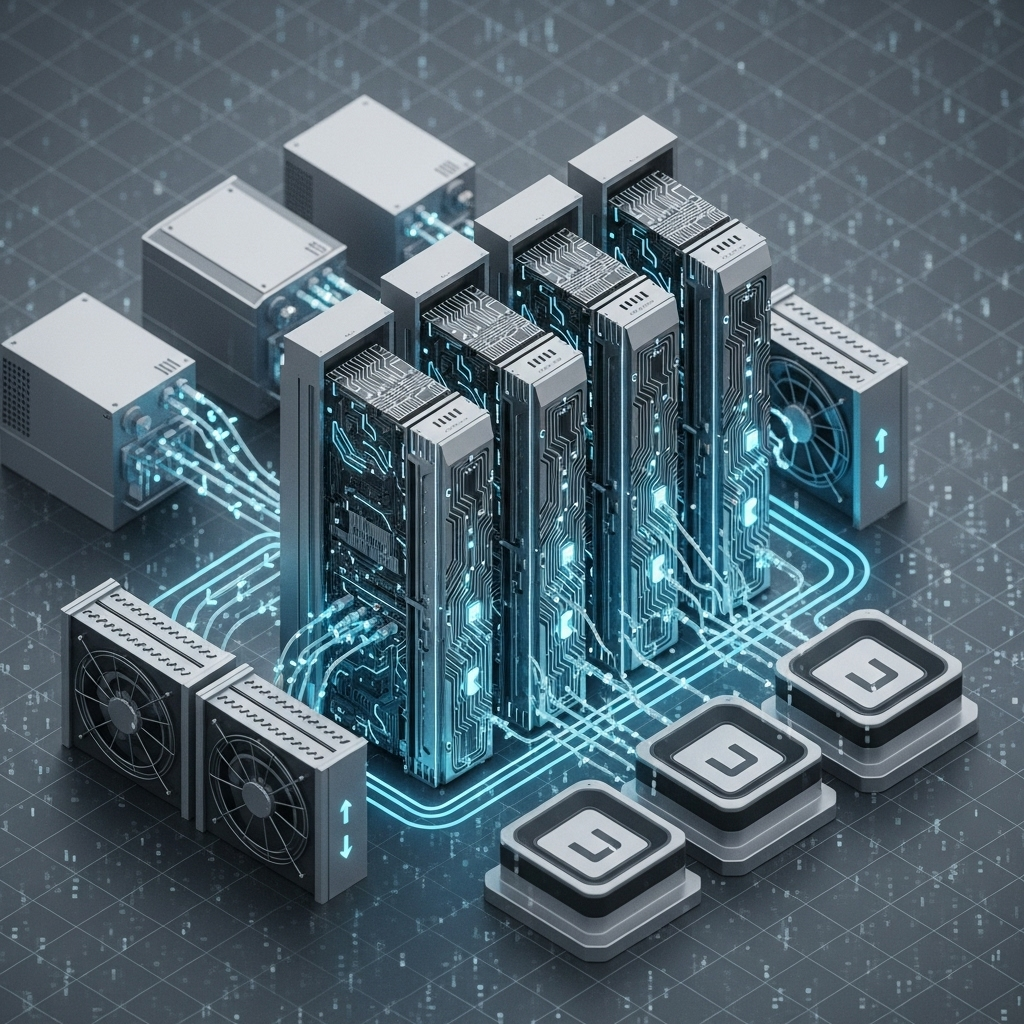
Denser on-prem AI hardware is collapsing the data center footprint and widening the I/O firehose, forcing organizations to completely rethink rack layouts, power delivery, cooling strategies, and the way datasets are placed near GPUs. As GPU density and storage performance race ahead, the impact on total cost of ownership (TCO) and long-term infrastructure flexibility is profound—and the tradeoffs are shifting fast.
Why Denser On-Prem AI Hardware Matters Now
In the past, scaling on-premises AI meant wrestling with a series of painful tradeoffs: more GPUs per rack usually strained power, overwhelmed cooling, and often resulted in I/O bottlenecks that left hardware idle. The latest hardware wave—anchored by multi-node blade servers and high-throughput NVMe—breaks that cycle, allowing compute density and storage performance to rise together in a manageable operational envelope. Organizations planning a hardware refresh must now make near-term choices that will determine the longevity and flexibility of their AI stack.
The Shift to Multi-Node Blade and GPU-Dense Servers
Today’s hardware refresh cycles are marked by a move away from single-box, monolithic servers toward modular, chassis-based platforms that share power, cooling, and management. This architecture paves the way for high node density per rack unit and streamlines everything from cable management to maintenance windows. Vendors like Gigabyte are deploying chassis that accommodate both AMD EPYC and Intel Xeon processors, while increasingly integrating liquid cooling to tame the heat generated by concentrated GPU clusters. These systems let data centers stack more compute within the same physical footprint, maximizing performance per rack without escalating operational complexity.
A standout example is MiTAC’s G8825Z5, which packs eight AMD Instinct MI325X GPUs into a compact chassis. Such dense configurations are rapidly becoming essential for AI training clusters, where packing as many interconnected GPUs as possible leads directly to shorter model training cycles. The ability to deploy powerful GPU clusters in a single enclosure redefines physical scaling and sets the stage for more resource-efficient AI deployments.
Feeding the Beast: NVMe Gen4 Today, Gen5 Next
Stacking more GPUs only pays off if you can feed them data without delays. PCIe Gen4 NVMe SSDs now deliver the low-latency, high-bandwidth access demanded by both AI training and inference workloads. Drives like the SanDisk WD Blue SN5100 offer sustained throughput high enough to keep dense clusters busy, shifting the cornerstone of high-capacity enterprise storage from central arrays to local, direct-attached SSDs (see more on the evolution of flexible enterprise storage).
When training large models, rapid shard prefetch and spill-to-local-disk behavior mean fast NVMe is crucial to moving datasets efficiently into GPU memory; for inference, caching models and feature stores locally on NVMe drastically reduces tail latency. As PCIe Gen5 SSDs come online, the available bandwidth per node will more than double, giving even more headroom for concurrent GPU jobs and mixed training/inference workloads, and solidifying the practice of keeping large datasets close to compute.
Data Center Implications: Power, Cooling, and Fabrics
The move to higher-density racks changes the operational playbook. Power delivery units (PDUs) and cabinet circuits must be upgraded to handle concentrated loads, and facility teams find themselves deploying more robust electrical infrastructure per aisle. Dense servers packed with high-TDP GPUs concentrate more heat than traditional racks, pushing traditional air cooling to the edge—and making direct-to-chip liquid cooling a mainstream requirement rather than a fringe luxury. As teams shift more bandwidth to local NVMe, designers must also rebalance data pipelines and network/top-of-rack fabrics to ensure that storage or networking do not become the new choke points in otherwise cutting-edge AI stacks.
Procurement and Refresh Strategy
Today’s procurement calculus has fundamentally changed. Multi-node blade systems require a higher upfront investment—chassis, blades, and shared infrastructure come at a premium—but the cost is amortized over significantly more processing capacity per rack. As cabling gets shorter, top-of-rack links fewer, and cooling energy per TFLOP drops, total cost of ownership (TCO) tilts in favor of blades over time (see ServerWatch).
At the same time, the choice of NVMe SSDs becomes a direct performance lever. Fast PCIe Gen4 (and soon, Gen5) SSDs can drastically shorten data transfer times for AI training, enabling swifter rollout of new models and shrinking the development window for AI-powered products and services. Procurement teams must therefore weigh the incremental cost of high-performance SSDs against the performance and business value unlocked by reducing cycles—and how this accelerates “AI agents in enterprise” adoption seen in real-world deployments (The Acceleration of AI Agents in Enterprise Solutions).
Edge-Ready Architectures
As AI inference increasingly moves closer to the data—whether in factories, on vehicles, or for real-time video analytics—dense, ruggedized clusters built on blade and compact GPU designs will become the foundation. These designs enable orchestration and management to scale across constrained, distributed environments, unlocking new applications at the edge. For more on how orchestration and controller patterns adapt at scale, see Small Controllers, Quantization, and Orchestration: Agentic AI at Scale.
The Outlook for the Next Year or Two
The march toward higher compute and storage density shows no sign of slowing. In the coming months, multi-node platforms are likely to move from high-end outlier to standard issue for new AI deployments. Large-scale adoption will drive a wave of data center upgrades—including the now-standard use of direct liquid loops or rear-door heat exchangers for thermal management in dense clusters. The transition to PCIe Gen5 SSDs will further uncap local I/O bottlenecks. However, attention must be paid to persistent supply constraints with advanced GPUs and HBM memory, which could dictate the pace of rollout even when local storage and interconnects race ahead.