Introduction
Quantum-enhanced subsurface radar has moved from theoretical ideas to working prototypes with a clear path to field trials. Lab work is drawing archaeologists, survey firms, and regulators into a debate about performance gains when switching from lab benches to real-world pits and trenches. A room-temperature, atom-based radar and microwave quantum illumination experiments illustrate potential advantages in noisy, weak signals.
How Quantum-Enhanced Subsurface Radar Works
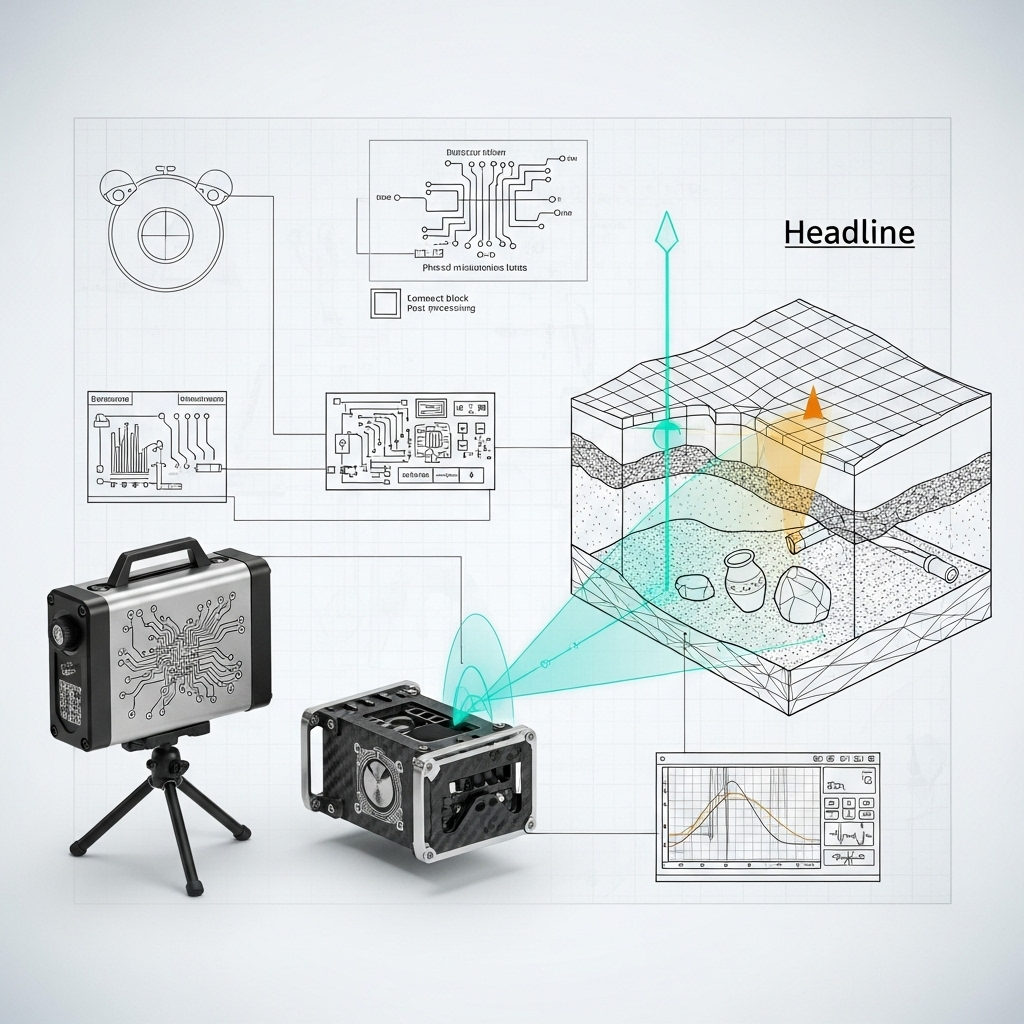
Classical GPR transmits microwave pulses and measures backscatter. Quantum approaches aim to improve sensitivity and material discrimination when returns are buried in noise. Two main strategies are emerging. Atom-based electrometry uses a vapor cell of laser-excited Rydberg atoms as a sensitive receiver; photonics readout replaces some conventional electronics. Microwave quantum illumination generates entangled microwave modes; one mode is sent to the target while detecting the retained idler with the return to improve detection under the same power budget.
The end-to-end chain looks familiar, but quantum advantage appears in higher sensitivity at very low returns and access to phase and frequency correlations that help discriminate materials. Atom-based readout avoids some receiver noise limits; QI exploits correlations to reduce error probability vs classical methods.
What Lab Demonstrations Have Actually Proved
Lab prototypes have crossed milestones but typically under simplified conditions. The atom-based approach has demonstrated room-temperature operation aimed at imaging buried objects, validated on a lab bench rather than through heterogeneous soil.
QI demonstrations show statistically significant advantages, such as faster detection times at fixed error bounds in high-noise environments. However, these tests use controlled targets and media with minimal clutter, and results are reported in detection-theory terms rather than full 3D reconstructions.
Engineering Constraints That Will Decide Field Performance
Field performance hinges on transmit power, detector sensitivity, and computational reconstruction. Portable systems must balance power budget with the need to extract weak signals. Detectors face challenges: laser stability and shielding for atom-based receivers; cryogenic elements for QI receivers. Real-world sites add dust, temperature swings, and clutter.
Industrial constraints include soil moisture, roots, rebar, and buried cables, which scatter or absorb microwave energy. Emission limits from regulations also set practical caps on frequency and power.
Near-Term Pilots and Promising Use Cases
Near-term pilots are likely in archaeology and utilities as portable packages mature. Early adoption will target shallow depths, noisy urban soils, and contexts where material discrimination reduces guesswork. Archaeology, utilities, and civil surveys stand to benefit from cleaner maps of buried assets and fewer exploratory digs.
The Path to Adoption: A Realistic Outlook
A practical roadmap emphasizes portable prototypes, validated across contrasting soils with buried artifacts and blind protocols. Progress will be measured by repeatable detection at target depths with clear comparisons to classical GPR baselines. Atom-based receivers may lead in portability by avoiding cryogenics, while QI systems stay relevant for specialized vehicle-mounted or stationary uses. In the medium term, expect a hybrid market where classical GPR remains primary but quantum-enhanced kits prove valuable in challenging sites.