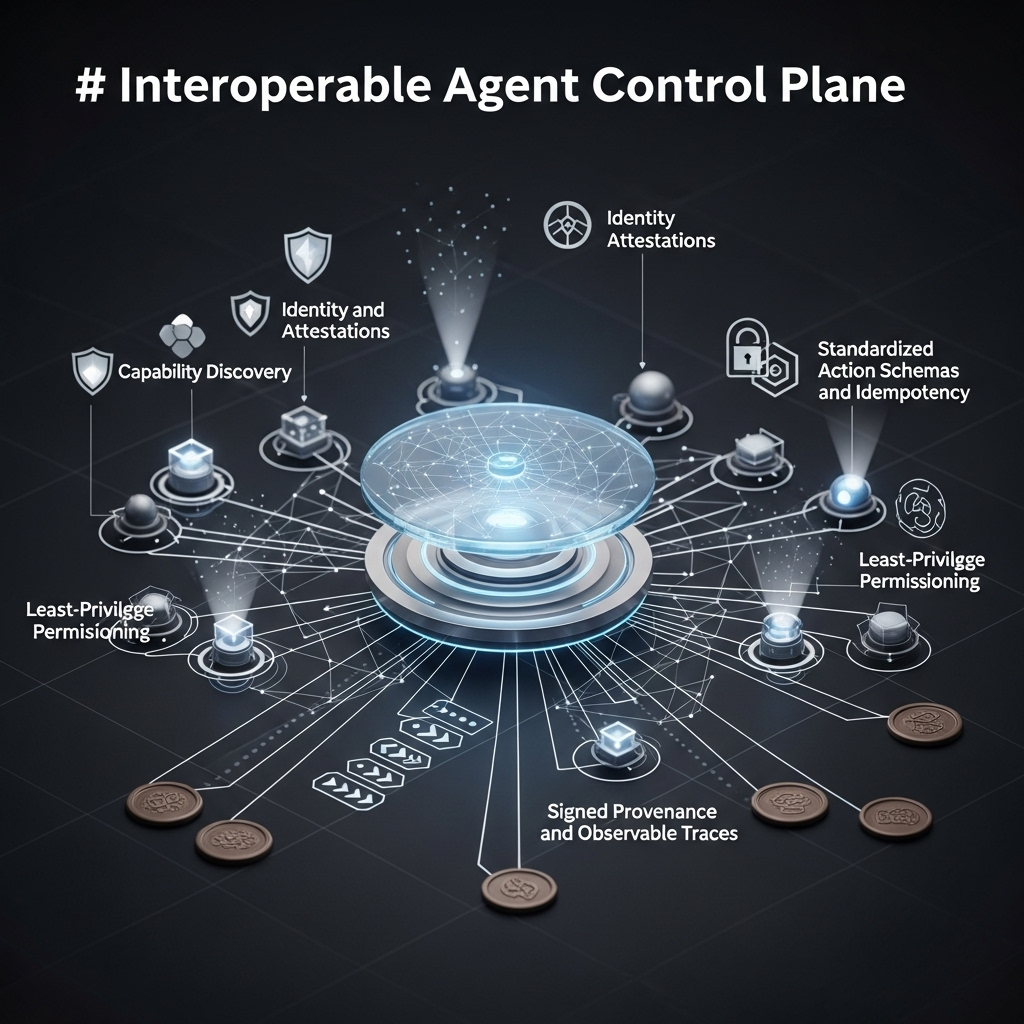
An interoperable agent control plane is no longer optional for enterprises, as a year of multi-agent pilots has revealed the same friction points repeatedly: agents can call tools and other agents, but discovery, permissioning, and provenance remain ad hoc. To solve this, protocol work around the Model Context Protocol (MCP) and agent-to-agent (A2A) messaging is converging on a practical “control plane” for AI systems that promises to make these challenges governable at scale, as detailed by efforts like the official MCP specification. This convergence is already shaping vendor strategies and will soon flow into procurement language. As the specifications coalesce, the question for platform architects and enterprise buyers isn’t whether to adopt them, but how quickly protocol choices become strategic dependencies.
Why Now: Pilots, Protocol Momentum, and Strategic Dependency
Early deployments taught hard lessons: a clever agent without standard discovery, scoped permissions, or tamper-evident traces is hard to scale beyond demos. The arrival of pragmatic standards—MCP for model-tool exchange and nascent A2A patterns for agent coordination—gives teams a chance to replace hand-rolled glue with interoperable rails, with backers publishing open specs and SDKs to make tools and data sources discoverable in a consistent way (see Anthropic’s announcement).
For buyers and regulators, this protocolization changes the risk calculus. Instead of auditing each agent-tool pairing as a one-off, they can look for conformance to shared primitives and contract for those behaviors up front. This shift marks the emergence of an “internet control plane” for agents, where governance is enforced by the rails themselves—a core theme in building foundational protocols for AI agents.
What the Emerging Specs Promise in Practical Terms
At its heart, this effort aims to standardize three things. First, a machine-readable “context envelope” that defines what information a model can see and under which constraints. Second, a message format for interactions—between a host application and tools in MCP, and between agents in A2A—so that requests and responses are predictable. Third, conventions for metadata and identity that bind actions to actors and environments in a way that both humans and machines can inspect, as outlined in the MCP specification.
Crucially, these primitives are designed not only for connectivity but for governance. Discovery flows, explicit permission prompts, and capability descriptors let agents learn what exists and negotiate access, rather than assuming unlimited privileges. This structure provides a foundation for operational guarantees like idempotent behaviors and traceable decision points, as platforms can record and verify signed provenance for audits.
From Integrations to Contracts: Procurement on New Rails
When discovery, permissioning, and provenance become standardized, teams stop building custom integrations for every agent-tool pair. Tool owners can publish a capability descriptor, agent platforms consume it, and permissioning is negotiated per task. This shifts governance from brittle, manual gates to consistent, testable behaviors encoded in the rails, allowing procurement to require protocol conformance instead of bespoke assurance.
Discovery and Composition
In a protocolized world, an agent can query a capability directory to discover a payment tool, read its machine-readable descriptor to understand its inputs and policy requirements, and then request a narrowly scoped grant like “issue refund up to $250 for order 1234.” The Model Context Protocol formalizes this layer, allowing teams to wrap legacy APIs behind compliant descriptors rather than maintaining one-off SDKs. The descriptor communicates constraints, the grant conveys time-bound authority, and the tool validates both before execution.
Permissioning and Least Privilege
A typical flow involves cryptographic identity for every actor—human, service account, or agent. An agent proposes an action and requests the minimal scope required; an attestation authority issues a short-lived credential bound to that scope; and the tool enforces it, logging the signed request. This default-deny posture shrinks the blast radius compared to the brittle “master API key” model. Scoped, attested grants enable precise revocation, contextual prompts for high-risk actions, and machine-readable justifications that downstream policy engines can evaluate.
Auditability, Provenance, and Compliance
Signed provenance and observable traces let auditors reconstruct who asked what, what the agent intended, and which tool produced the output. Standardized action schemas, idempotency keys, and clear error semantics ensure that actions behave predictably and retries don’t corrupt state. This structured data feeds compliance automation, policy checks, and incident response. In regulated contexts, being able to show a verifiable chain from identity to outcome provides powerful evidence of reasonable controls, a concept detailed by early adopters like Anthropic.
Implementation Patterns to Watch
A practical stack is taking shape around several key components. Organizations will need to choose between centralized identity authorities that fit neatly with enterprise IAM and decentralized models that improve portability. Either way, mapping agent identities to human operators is critical for accountability. These agents will rely on capability registries—versioned service catalogs for tools—that may be federated by business unit or centralized to enforce uniform policy. For actions to be reliable, teams must standardize on shared action schemas, using idempotency keys to make retries safe and canonical errors to ensure agents can distinguish transient from terminal failures. Finally, all of this must be captured in signed provenance traces, providing a chain of custody for every agent action. Policies for trace retention and access must be designed with legal counsel to ensure operational telemetry doesn’t become a liability.
Key Risks and Open Challenges
Despite the promise, significant challenges remain. The interoperable vision could be undermined by centralization, interoperability drift, or privacy concerns.
- Centralization and trust concentration: Attestation authorities and capability registries could become single points of control or failure, creating new forms of vendor lock-in.
- Interoperability drift and fragmentation: Competing schemas and divergent permission models could recreate today’s bespoke integration mess under a new name.
- Provenance privacy and scale: Recording signed traces at high fidelity raises privacy, storage, and performance issues that can derail production deployments.
Governance and Due Diligence: What Buyers Should Require
Protocol choices will soon surface in RFPs and vendor due diligence. Procurement teams should ask for MCP-compatible capability descriptors, conformance with scoped, revocable permissioning, and access to signed, machine-readable traces for audit. Contracts should specify attestation policies, revocation guarantees, and audit access schemas. Regulators are unlikely to certify models directly; they will assess systems. This pushes organizations toward auditable control planes where identity, scope, and provenance are verifiable at the protocol level rather than inferred from logs.
Practical Next Steps for Enterprise Teams
Start with the brownfield. Wrap one or two high-value internal APIs with MCP-style capability descriptors and negotiate scoped grants for a realistic workflow. Require attested identities for agent integrations and bind them to existing IAM. Instrument idempotency keys and pilot signed trace capture with legal and privacy teams to set retention and access policies. A gatekeeper proxy that enforces descriptors and scopes can reduce risk while you retrofit legacy systems. Over a few quarters, a central capability registry and adapter libraries will enable a progressive migration away from bespoke adapters.
Mid-term Forecast: Consolidation Around Interoperable Rails
Over the next 2-5 years, consolidation around a small set of interoperable primitives looks likely. The tool layer, anchored by a protocol like MCP, will likely win on practicality. On top, one or two A2A-style coordination patterns will solidify. Procurement in regulated industries will increasingly require protocol conformance, including attestations and signed traces as table stakes. A secondary market will emerge for audit tooling that consumes this signed provenance.
However, failure modes remain plausible. If large platforms push incompatible variants, we could see de facto lock-in. On balance, the most realistic outcome is a two-layer equilibrium: an open base for tools and a small number of widely adopted coordination patterns. Teams that start piloting discovery, scoped permissioning, and signed provenance together will capture early operational trust and be best positioned as the control plane hardens.